
Mathews County Court Records After Arrest
The court-record path after a Mathews County arrest is separate from the Middle Peninsula Regional Security Center roster. The jail profile can show the booked name, admit date, charge text, court type, court date, bond, bond type, charging agency, and arresting agency. That is an early custody record. The court record shows what the court and prosecutor do next: case number, formal charge wording, hearing dates, continuances, disposition, plea, dismissal, nolle prosequi, conviction, sentence, fines, costs, appeal, or transfer.
The normal flow is arrest, booking, first appearance, prosecutor review, and then court-file activity. Some lower-level matters may begin by summons instead of jail admission, so a person can have court records without ever appearing on the current jail roster. For custody and intake detail, use the Mathews County jail inmate records path. For booking photos tied to current public profiles, use the jail roster mugshots material. The court record is the better source for charge status and final outcome.
Find Mathews County Court Records
Virginia provides official court-search systems for public case information. Mathews adult misdemeanor, traffic, and many preliminary felony matters usually begin in General District Court. Felony indictments, felony dispositions, and appealed or transferred criminal matters move through Circuit Court. Juvenile and domestic relations matters are handled under separate rules, and juvenile records should not be treated like adult public court records.
- Start with the MPRSC profile if the person is in current custody. Copy the name, admit date, charge wording, court type, court date, charging agency, and arresting agency.
- Open the General District Court Online Case Information System for district-court criminal, traffic, and preliminary felony matters.
- Use the Virginia case status hub or OCIS statewide case search for broader case-status access where available.
- Search by Mathews locality, defendant name, case number, or hearing date. Open each matching case and compare charge text, date, court, and status.
- If no case appears, check again after the first appearance or call the correct clerk. New court records may lag behind jail booking data.
The Mathews General District Court branch lists criminal and traffic court functions, office hours, and phone 804-725-2242. The Mathews Circuit Court Clerk lists criminal-action filing duties, case-search access, records-room information, and phone 804-725-2550. When the online portal is down, incomplete, or unclear, the clerk is the official route for public case-status questions.
| Field Label | Type | Required | Notes |
|---|---|---|---|
| Court / locality | Dropdown or search selection | Usually yes | Choose Mathews or the Virginia court where the charge was filed. |
| Defendant name | Text | Depends on search mode | Use full legal name when known; spelling and initials can affect results. |
| Case number | Text | Depends on search mode | Best when copied from a court notice, warrant, summons, or attorney record. |
| Hearing date | Date | No | Useful when the MPRSC profile already lists a court date. |
| Search / Submit | Button | Yes | Portal labels vary, but the function runs the selected case search. |
Mathews Court Records Offices
Mathews court records are local even though the jail is regional. The courthouse cluster on Buckley Hall Road can create confusion because the Sheriff's Office, General District Court, and Circuit Court Clerk are close to one another, while the jail is in Saluda. A Mathews arrest may be booked at MPRSC, but the court case is tracked by the Virginia courts and the Mathews clerks.
The county's General District Court page is the official local source for district-court phone, hours, and court days. The screenshot below shows the local court branch contact context from that source.
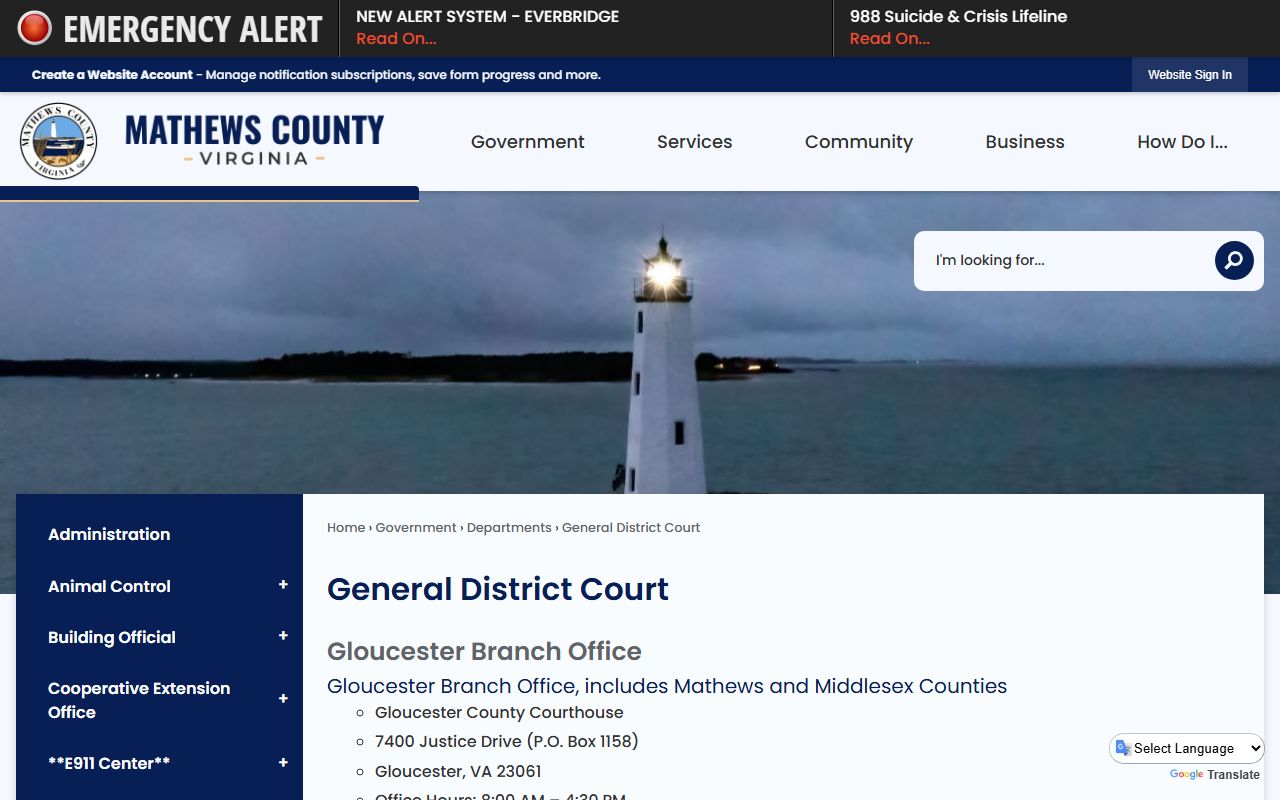
Use that court for public adult misdemeanor, traffic, and preliminary felony case routing, then verify case-specific dates through the court portal or clerk.
The Circuit Court Clerk page identifies criminal-action filing duties and records access for higher-level criminal matters.
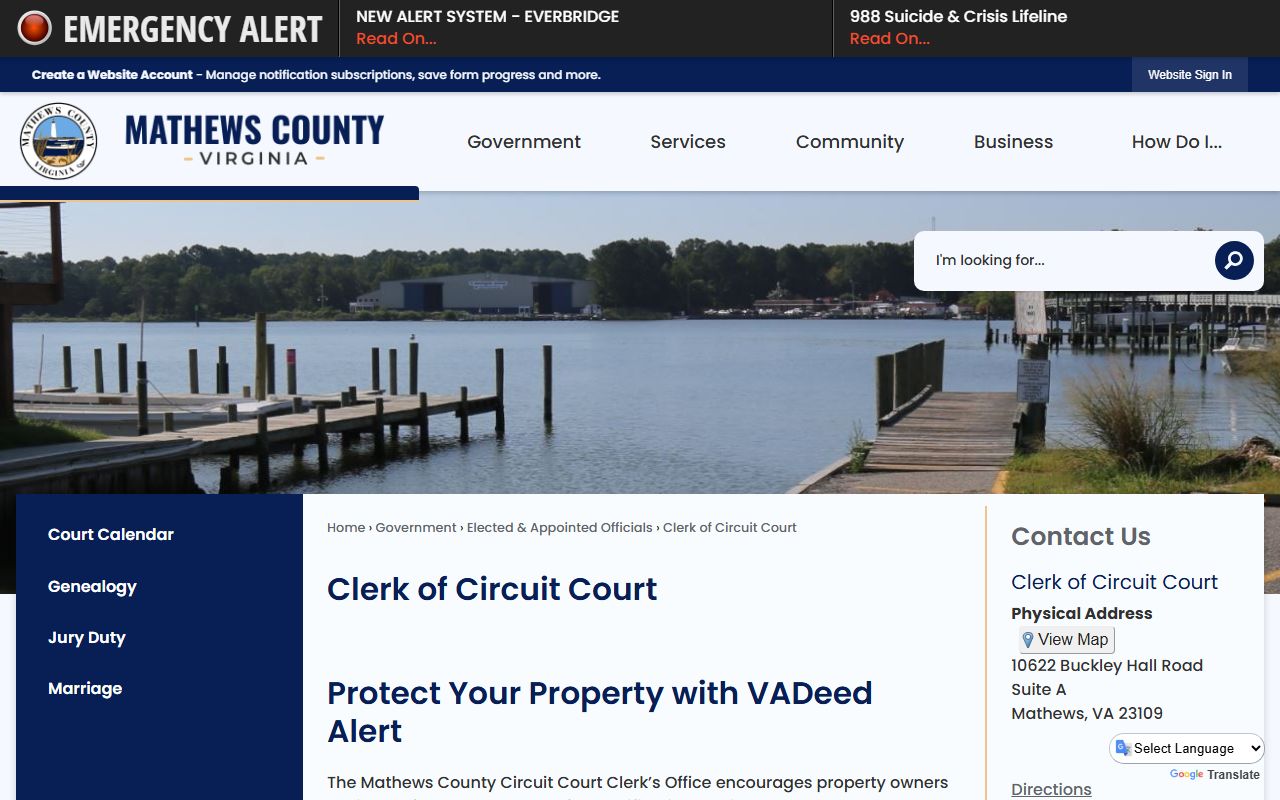
Circuit Court becomes central when a felony is indicted, transferred, appealed, or resolved there rather than in district court.
Charges After Mathews Arrest
A jail arrest can start with law-enforcement charge wording or a warrant basis for custody. That wording is not always the final formal charge. The Commonwealth's Attorney may proceed with the charge as listed, amend it, reduce it, move not to prosecute it, or seek an indictment for a felony. The court docket is the authoritative place to track those formal decisions.
| Document | Who Uses It | Common Role | Where It Points |
|---|---|---|---|
| Complaint or warrant | Officer, magistrate, or prosecutor | Starts or supports a criminal matter after an arrest or summons. | Often district-court case activity first. |
| Information | Commonwealth's Attorney | Formal prosecutor-filed charge in cases where that procedure applies. | Case record and court docket. |
| Indictment | Grand jury | Formal felony charging instrument returned through grand-jury process. | Circuit Court felony prosecution. |
The Mathews Commonwealth's Attorney page lists the prosecutor's office contact block and criminal-court date references.
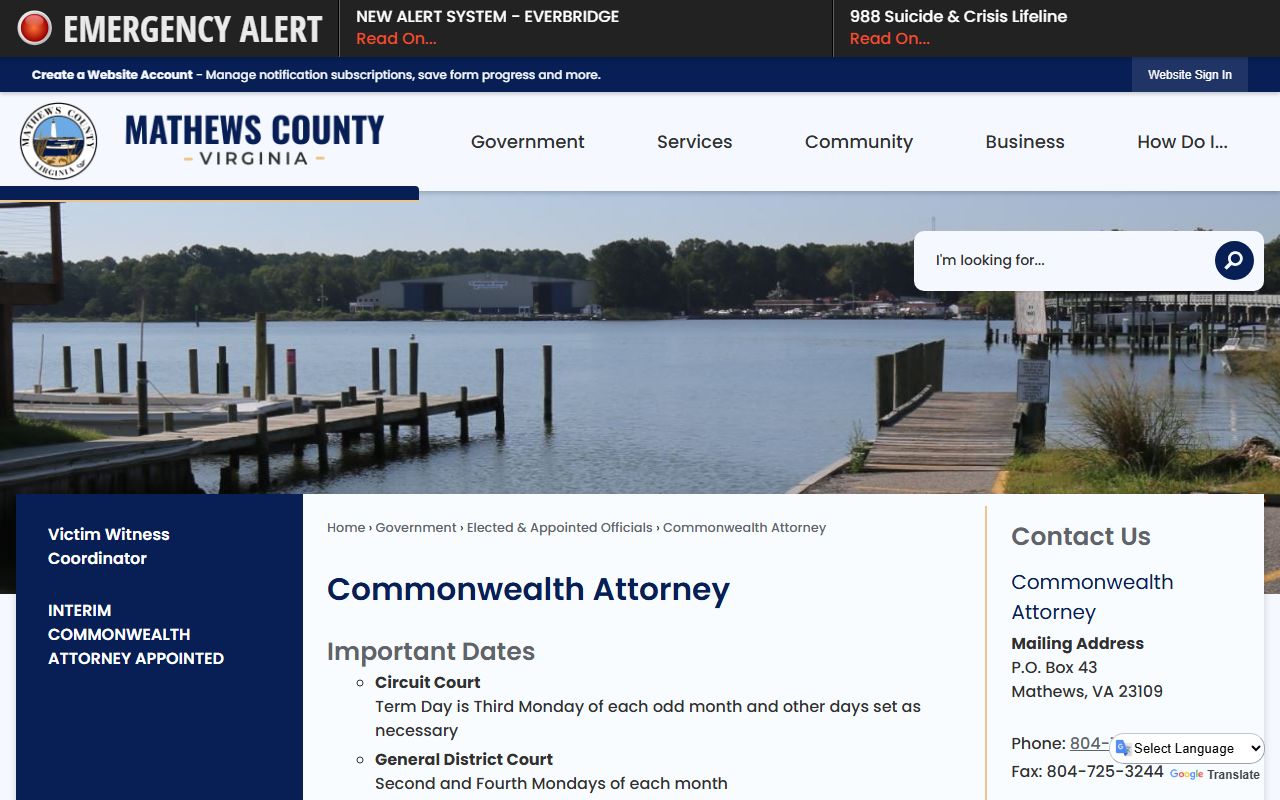
As of Feb. 23, 2026, county notice identifies Kimberly Hensley as Interim Commonwealth's Attorney after appointment by judges. That date matters because the prosecutor named on older records may differ.
Mathews Charge Status Records
Charge status can change more than once between booking and final disposition. A booking charge may be based on the arresting officer's paperwork, while the court case reflects what is filed, amended, heard, or dismissed. Do not treat a current jail charge as proof of conviction. It is a snapshot from custody records unless the court record shows a plea, verdict, or sentencing entry.
| Status | What It Means | Why It Matters |
|---|---|---|
| Pending | The charge is open and has not reached final disposition. | Future hearings, bond terms, or amendments may still occur. |
| Amended or reduced | The formal charge changed from the first booking or filing entry. | The court record may no longer match the jail profile wording. |
| Dismissed | The court ended that charge without a conviction. | Other charges in the same case may still remain open. |
| Nolle prosequi | The prosecutor chose not to proceed on that charge at that time. | It is not the same as a guilty finding. |
| Convicted | A guilty plea or verdict was entered. | Sentencing, fines, costs, probation, or jail/prison terms may follow. |
Bond After Mathews Arrest
Bond in a Mathews case is set through magistrate or court action, not by the website roster itself. The MPRSC profile may show bond and bond type per charge, but that line does not explain every release condition. Multiple charges can carry separate bond entries. A person may also have a hold from another court, probation or parole, VADOC, ICE, USMS, or another agency that blocks release even when a local bond line appears.
| Bond Type | How It Works | Caveat |
|---|---|---|
| Personal recognizance | Release based on a promise to appear and follow conditions. | No cash deposit may be required at release, but conditions still apply. |
| Secured cash or surety | Money or a surety bond is required before release. | Ask the court, magistrate, or bond agent about refunds and fees. |
| Property bond | Real property may secure release through court-approved procedures. | Approval and paperwork are case-specific. |
| No bond or hold | The person cannot be released simply by paying money. | Another matter may require court review or agency clearance. |
Official MPRSC pages reviewed for this build did not publish a dedicated bond-posting instruction page. For release logistics, call MPRSC at 804-758-2338. For case entries, hearing dates, or court-set release terms, contact General District Court or the Circuit Court Clerk, depending on where the case is pending.
Note: A roster bond entry is not a final court outcome and does not prove that release is available.
Mathews Warrants and Arrest Records
No official online active-warrant list for Mathews County was located in the research sources. The Sheriff's News and Information page points to TIP411 and the MathewsCo Sheriff app for anonymous tips and alerts, but those tools were not documented as a warrant-search database, a jail roster, or a mugshot gallery. The safest public-record route is to use the court portals for public case activity and contact the local office tied to the warrant or case.
For local law-enforcement warrant questions, the Mathews Sheriff's Office phone is 804-725-7177. For district-court criminal or traffic warrants and bench-warrant context, call Mathews General District Court at 804-725-2242. For circuit felony case records, call the Circuit Court Clerk at 804-725-2550. A federal fugitive notice is different from a Mathews warrant; the U.S. Marshals Eastern District of Virginia is a federal resource, not a county court record.
- Arrest warrant
- A court or magistrate order to take a person into custody based on a criminal allegation.
- Bench warrant or capias
- A court order often tied to failure to appear or violation of a court order.
- Search warrant
- An order to search a place, person, or property. It is not the same as a custody warrant.
- Fugitive warrant
- A warrant tied to a person wanted by another jurisdiction.
Charges Versus Convictions
A Mathews County court records after jail arrest lookup should always separate an accusation from an outcome. A person can be arrested, booked, charged, and later have a charge reduced, dismissed, or not prosecuted. A conviction requires a guilty plea or verdict. Public records may show both stages, but they do not mean the same thing.
| Point of Comparison | Charge | Conviction |
|---|---|---|
| Stage | An accusation or formal filing after an arrest, summons, warrant, or indictment. | A final guilty plea or verdict entered by the court. |
| Proof level | Can begin from probable cause, officer paperwork, or prosecutor filing. | Requires proof beyond a reasonable doubt or a valid guilty plea. |
| Record meaning | Shows what was alleged and tracked in court. | Shows that the court entered a finding of guilt. |
| Possible result | May be pending, amended, dismissed, or nolle prosequi. | May lead to sentence, fines, costs, probation, jail, or prison. |
Sealed or Expunged Records
Virginia law allows some qualifying police and court records to be expunged after events such as acquittal, dismissal, mistaken identity, or other listed outcomes. The research source flags Code of Virginia section 19.2-392.2 as the key expungement statute, with major changes taking effect December 1, 2026. Eligibility is specific. A dismissed charge does not vanish from every public system unless the required court process applies.
| Point of Comparison | Sealed | Expunged |
|---|---|---|
| Public visibility | Hidden or restricted from ordinary public view. | Removed or treated under the expungement order's terms. |
| Covered records | Can depend on the court order and record type. | Can include qualifying police and court records listed by law. |
| Law-enforcement access | May remain available in limited official contexts. | May still have narrow legal exceptions depending on the order and law. |
| Mathews route | Ask the court that handled the case about public access limits. | Review eligibility with the court or counsel before relying on removal. |
Restricted Mathews Court Records
Virginia public-record rules do not make every criminal record open in the same way. Code of Virginia section 2.2-3704 provides the general FOIA inspection and copying process. Sections 2.2-3706 and 2.2-3706.1 set limits for law-enforcement and criminal investigative records. Those limits matter for arrest reports, investigative files, photos, juvenile material, and active cases.
For Sheriff's Office records that are not online, the Mathews Sheriff's Office directs FOIA requests to P.O. Box 190, Mathews, VA 23109, or phone 804-725-7177. For formal charges and outcomes, court portals and clerks are the right source. A jail record can show that a person was held. A court record shows whether the charge moved forward and how the case ended.
Important: Public case lookups are not consumer reports and should not be used for employment, credit, housing, insurance, or other FCRA-covered decisions.